I thought I knew SEO.
Not deeply, not professionally, but enough. I implement the basics in my work. Alt tags, meta descriptions, semantic HTML. I'm an AI power user. I read things. I stay curious. I figured I had a decent handle on it.
Turns out I didn't. Not even close.
The biggest self-humiliation isn't not knowing something. It's thinking you know something and finding out you don't. That specific flavour of embarrassment is its own category.
One Random Thursday
I was scrolling Instagram after work when an ad for Ahrefs Evolve Singapore 2026 stopped me for half a second. Then I kept scrolling.
SEO conference. Not really my world. I'm a frontend dev who handles light marketing on the side. I build things. I don't keynote about keyword clusters. I figured it would be the same energy as every guru-adjacent thing that floods your feed and promises to change your life for three easy payments.
The algorithm decided I was interested. The ad came back. Every time I opened Instagram, it was there, quietly insisting. I bought the ticket before I could talk myself out of it.
I'm introverted. Socially awkward in the way that isn't quirky or endearing, just genuinely exhausting to navigate. Starting conversations with strangers is one of my least favourite human experiences. A room full of SEO specialists felt like the exact wrong place for someone like me.
I went anyway. Fugg it.
What Happens When You're the Odd One Out
First day, workshop. I was nervous enough to be slightly late, which is its own kind of painful. But then Constance Tan from Ahrefs started talking and something shifted.
Every question I'd been sitting on for months, the ones I'd half-answered myself through trial and error and AI rabbit holes, started getting actual answers. Does this work? Yes. What about this? Also yes, but here's why. The kind of clarity you can't really get from documentation or a YouTube tutorial because you don't know how to phrase the question properly until someone just answers it in front of you.
That alone would have been worth it.
Then Zwe from White Press Agency basically adopted me, showed me around, introduced me to people. And something I didn't expect happened: being in a room full of specialists from completely different backgrounds, all inside the same discipline, watching how each person approaches the same problem differently, it opened something up. Questions I didn't know I had started getting answered just by listening.
What Loki Yan Said That Stayed With Me
Loki Yan walked on stage and I was already in absorb mode by then. But when he started talking about schema and his slide had Nuxt on it, my framework. Something clicked that I'm still processing.
It wasn't one insight. It was a cascade. Realisation after realisation, the kind that doesn't feel like learning new information but like finally seeing the shape of something that was already there.
The code I write every day has an entire layer inside it I wasn't writing with intention. Schema markup, structured data, the signals we send to search engines and increasingly to AI systems through the architecture of our work. I was already writing it. Just not thinking about what it was saying.
What Frontend Devs Are Missing (And It's Already In Our Code)
Here's the thing nobody tells you when you're learning to build: SEO isn't a separate discipline you bolt on after you ship. It lives inside the decisions you're already making. The HTML structure. The image tags. The metadata. The way you name things and nest things and load things.
We don't have to become SEO experts. But the basics are already part of what we write. We're just not writing them with intention.
1. You've been doing SEO without knowing it (alt tags edition)
I was already writing alt tags. I thought I was doing it for screen readers, which is correct and important. Turns out I was also doing SEO and just not thinking about it that way. The intention behind the description changes the quality of it.
2. Your site is already in a conversation. Schema decides what it says.
Structured data tells crawlers not just what your page contains but what it means. For frontend devs this lives in your JSON-LD, your semantic HTML, your meta tags. If you're not writing it with intention you're leaving the conversation half-finished.
3. Nuxt, Next, Astro — your framework choice has opinions about SEO
SSR, SSG, client-side rendering. These aren't just performance decisions. They affect how your content gets indexed, how fast it appears, whether it gets read at all. Worth knowing.
4. If it's slow, that's on you. Not the SEO person. You.
Bundle size, render blocking, image optimisation. Page speed is an SEO signal and it lives inside the build. If it's slow, it ranks lower. That's a dev problem.
5. GEO, AEO, and why the AI layer is now a frontend problem
AI systems are citing sources now. The sites that get cited are structured clearly, written with authority, and built in a way that's easy to parse. That's a frontend and content problem, not just an SEO one.
The Translator Problem
Here's where Echo Studio comes in, honestly.
I run Echo Studio, a one-person creative shop working with independent brands across Southeast Asia. SEO isn't my primary discipline. Building is.
Most clients either have a dev or an SEO person. Rarely both, and almost never someone who speaks both languages fluently. The dev builds something technically solid that nobody finds. The SEO person optimises content on top of a structure that's fighting them the whole way.
The gap between those two is where work gets buried.
I went to Ahrefs Evolve as a dev. I came back as something closer to a translator. And I think that's actually the more useful thing to be.
See You in 2027
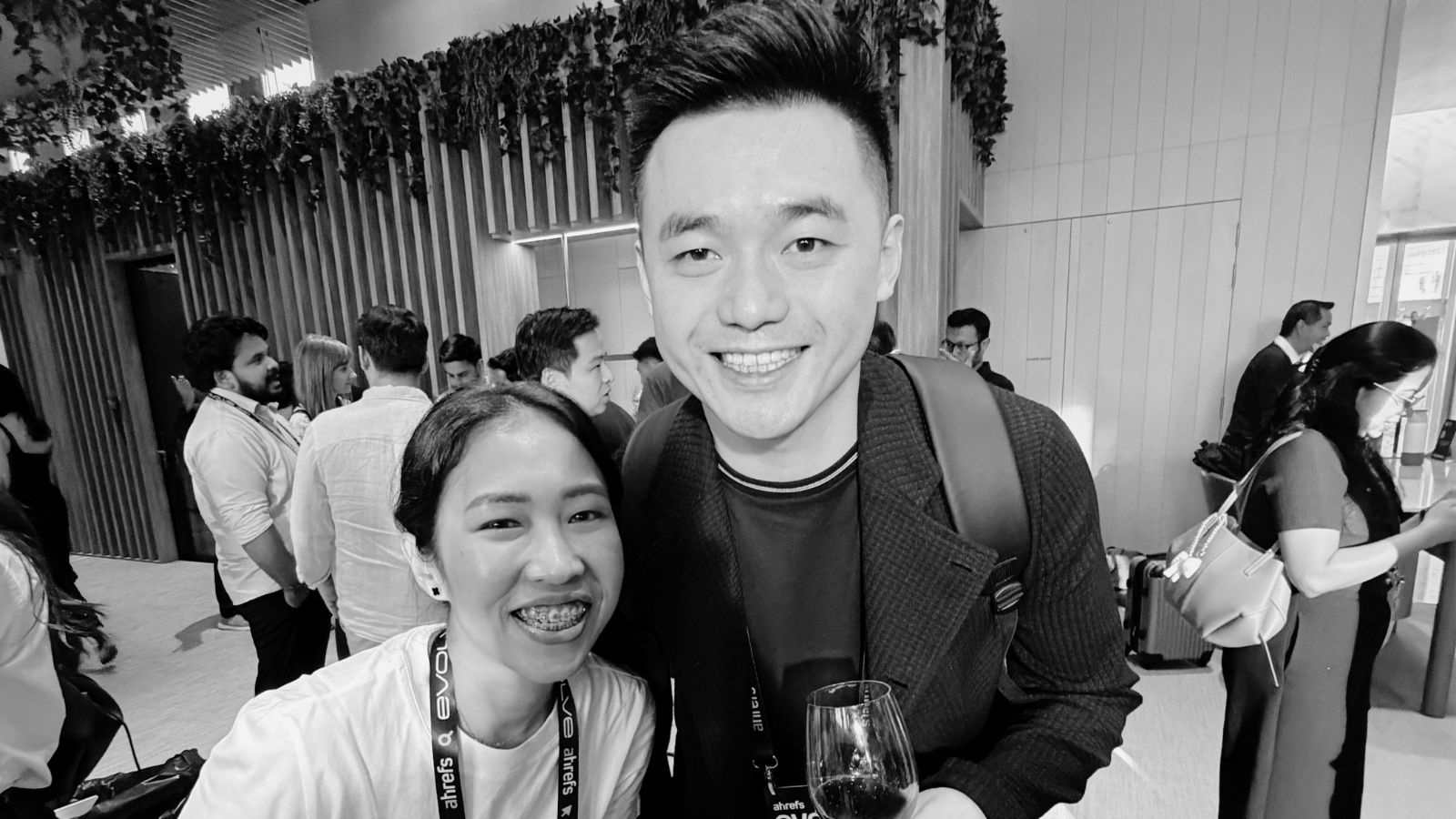
After the session I spoke with Loki in person. Brief, probably forgettable for him, not for me.
That conversation settled something. I came home and made a decision: I'm going to learn this properly. SEO, GEO, AEO, everything in between. Not as a side curiosity or a "useful to know" checkbox. Seriously, the way I take the craft of building seriously.
I want to be a full stack marketer who can both build and amplify, correctly, intentionally, with actual understanding behind the decisions. That's the gap I want to close.
Loki doesn't know he became a mentor that day. But he gave me a clearer picture of where I want to go than anything I'd figured out on my own. That's a rare thing and I'm not taking it lightly.
More on how that's shaping the way Echo works on the studio page.