Every few decades, something breaks the information hierarchy. The people who built careers inside the old one panic. The ones paying attention get curious instead. We're here again.
Someone scared. Someone grieving a version of work that's changing faster than they can keep up with. Someone asking whether their skills still matter, whether their job still exists, whether they're already behind.
If you pay attention long enough, this stops feeling new. Evolution is just what things do. Plants adapt to drought. Animals mutate over generations to survive a shifting environment. Not because they planned to. Because the ones that didn't, didn't make it.
Human invention works the same way. We build something, then we want it faster. Then cheaper. Then smarter. Then we want it to do the thing we haven't thought of yet. Better, then more better, then not enough, then better again. We never stop.
The tools keep changing. Traditional SEO stretches into GEO, and I haven't even swallowed that up before it's already popping up and expanding into whatever the "pro" called it. Automation swallows entire job descriptions. AI generates in seconds what used to take days. But this specific panic, the one where the rules change overnight and nobody knows who wins, has a paper trail. A very long one.
So let's go back to the last time the information hierarchy broke completely.
Back to 1440
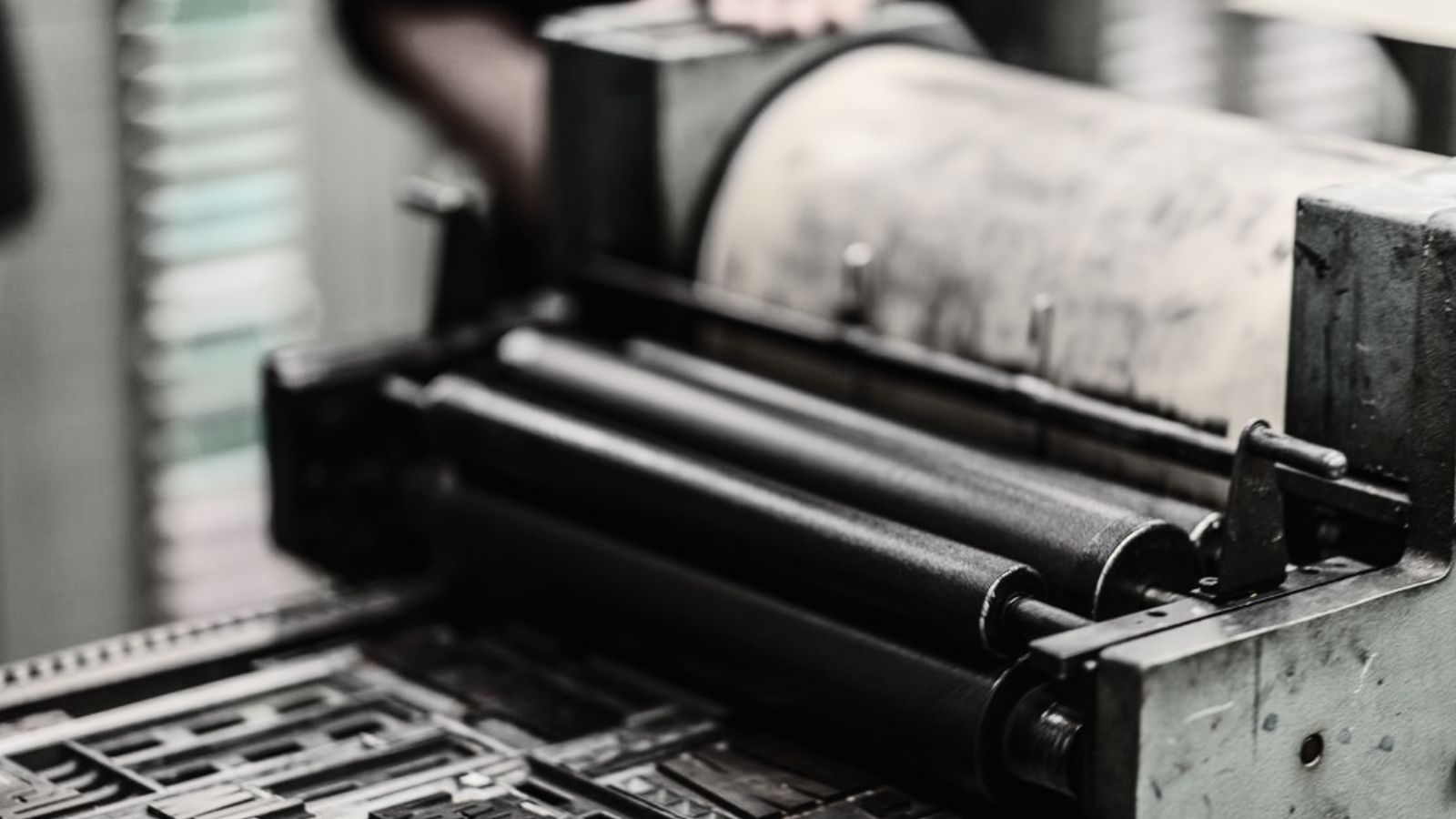
Johannes Gutenberg introduced the printing press. Before that, books were copied by hand. One book could take a monk years to produce. Knowledge was expensive, slow, and controlled by a very small group of people who had every reason to keep it that way.
Then suddenly anyone could print anything. And distribute it. Fast.
The church panicked. Governments panicked. Scholars panicked. Because information was no longer gatekept by the people who had always gatekept it.
Sound familiar?
Here's what that moment still teaches us.
The Pattern
1. Every generation has a Gutenberg moment → Disruption isn't new, it's structural
The printing press wasn't the first time an information hierarchy collapsed. And it wasn't the last.
Radio broke the monopoly on spoken broadcast. Television broke the monopoly on visual storytelling. The internet broke the monopoly on publishing. Social media broke the monopoly on who had an audience. Now AI is breaking the monopoly on who can produce at scale.
Every single time, the same panic. The same "this will ruin everything." The same people losing control of who gets to speak and who gets to be heard.
Disruption isn't a new phenomenon. It's a structural pattern that repeats every time a new medium lowers the barrier to entry. Understanding that doesn't make the change less real. But it does make it less surprising.
2. The people who panicked weren't wrong. They were just looking at the wrong thing. → The medium changes. The need doesn't.
The monks who copied manuscripts weren't wrong to be worried. Their specific skill, the painstaking manual reproduction of text, did become obsolete. Gutenberg didn't need them for that anymore.
But the need that skill was serving, making knowledge accessible, distributable, and findable, didn't go anywhere. It just moved to a new medium.
This is where most conversations about AI and job displacement go sideways. The question isn't whether your current tool or process will survive. Some of it won't. The question is whether you understand the underlying need you're serving well enough to move with it when the medium shifts.
The monks who understood that they were in the business of spreading knowledge adapted. The ones who thought they were in the business of calligraphy didn't.
3. Every panic is really a power struggle → Who controls the medium controls the conversation
The church didn't panic because books were bad. They panicked because they could no longer control which books existed, who read them, and what conclusions people drew.
Governments didn't panic because printing was dangerous. They panicked because they could no longer control the narrative at scale.
Every major disruption follows this pattern. The loudest voices against a new medium are almost always the ones who benefited most from the old one. That's not cynicism. That's just pattern recognition.
When you see mass panic about a new technology, it's worth asking: who had the most to lose from the old system? Because those are usually the people loudest about the new one being dangerous.
4. The world didn't end. It reorganised. → The question is always who reorganises first
After Gutenberg, the world didn't collapse. It reorganised around whoever figured out the new medium fastest.
Printers. Publishers. Eventually journalists. Eventually bloggers. Eventually creators. Eventually anyone with a phone and something worth saying.
Each time the medium shifts, there's a window. A period where the new infrastructure exists but most people haven't figured out how to use it properly yet. The people who move in that window, not recklessly but deliberately, tend to define what the medium becomes.
We are currently in that window with AI. The infrastructure exists. Most people are still either panicking or waiting. The ones quietly figuring out how to use it well are the ones who will define what it becomes.
5. The question was never whether to be scared of the press → It's whether you're going to learn how to print
Gutenberg's press didn't ask anyone's permission. It arrived, it changed everything, and then life continued. Just differently.
The people who spent the next decade arguing about whether it should exist missed the decade they could have spent learning to use it.
You don't get to vote on whether it happens. You only get to decide what you do during the window when it's still early enough to matter.
The question isn't whether to be scared. Fear is a reasonable first response to structural change. The question is what you do after the fear. Whether you stay in it, or whether you get curious about the press.
The Ink Is Ready
The printing press is 580 years old. The panic it caused is documented, studied, and resolved. We know how it ended.
It ended with more people able to read, write, publish, and be heard than at any point in human history before it. It ended with the democratisation of knowledge. It ended, eventually, with a better world for more people.
The disruption was real. The fear was valid. The outcome was worth it.
And the monks? Some of them kept doing calligraphy. Still do. Turns out hand-lettered manuscripts didn't disappear, they just became rare, and rare became valuable. The developers who still write every line by hand aren't obsolete, they're specialists. The SEO practitioners people keep eulogising? Still very much needed. Traditional SEO isn't dying, it's the barebone that GEO is built on. You can't optimise for AI-generated answers if the foundation underneath is broken. The designers who work without templates aren't behind, they're sought after. If you don't want to change, you don't have to. Just know that staying put is also a choice with consequences and occasionally, a very good market.
Your Gutenberg moment is happening right now. The press exists. The ink is ready.
Whether you learn to print, or perfect your calligraphy, just don't let fear be the thing making the decision for you.
If you want a second opinion on which one you're actually looking at, that's strategy & direction.